Pages

Thursday, April 26, 2012

When Should the Body Drop?

Nope--not talking about middle-aged spread here. This is about when the reader of a traditional murder mystery expects to come across the first victim.

Since authors are told to begin their novels in media res, literally "in the middle of things," some believe that in a traditional mystery the body should appear in the first chapter. Nothing can be a stronger hook for a reader than that, they argue. And it is a truth universally acknowledged that a reader in possession of a new book must be in want of a strong hook to keep them reading.

But is it always necessary to kill someone off in chapter one? Many don't think so. I just read a Carolyn Hart mystery where the body doesn't appear until page 81. It didn't feel like it took too long to get there. As she shows us, there are other ways to hook readers than by killing off a character.

In one typical story arc, we meet all the people in the closed community, learn about their mutual anger and distrust. Then the most hated character is found dead about 1/4 to 1/3 of the way through and everyone is a potential suspect. Think Murder on the Orient Express. This only works if the reader is fully engaged by the setting and characters as Christie enables us to be.

A twist on this is that a popular character is the one to die, making the act more heinous and finding the culprit more imperative. But either way, we have to come to know the characters before we can feel strongly about the murder.

In another typical story arc, a body is found early on and there is one obvious suspect who, of course, turns out to be innocent and would have been railroaded were it not for the protagonist's tireless investigation. This sort takes less time to get to the murder, and the bulk of the story is unraveling who really dunnit.

There are even some where the dirty deed is accomplished before the story opens. This story line can pick up with the victim's funeral, or even later with someone being (wrongfully) charged with the crime. It's harder for readers to have a strong feeling about the victim with this story arc, so the author needs to make us care more about the innocent person who's behind bars.

If you think about it, you've probably read each of these stories many times. Yet, each time it's different because of new characters, setting, and plot details.

I think I'm like most readers who choose traditional mysteries for their characters and the puzzle. For a first book in a series, I like to learn about the setting and become invested in the main characters. I know I'm reading a mystery, and eventually one of these folks is bound to drop dead. Sometimes figuring out who the victim will be is as much fun as figuring out who dunnit.

What do you think? When do you like to see the body drop?

Tuesday, January 10, 2012

Because we're those dog owners . . .

Darcy at 4 months
Several months ago, we adopted a little black rescue puppy that we were told was half Newfoundland. I checked out the breed and found that they were smart, intensely loyal, and couch potatoes--a good mix for us. So we brought him home and named him Mr. Darcy, after the hero of Pride and Prejudice. After all, he was destined to grow to be tall, dark, and handsome.

Newfoundland
Newfie's are huge--big-boned, deep-chested, and heavy-coated. They weigh 130-160 pounds when full grown. Naturally, we expected our puppy to grow to be enormous.  


But things don't always turn out as you expect. Over the past months, he has grown to be a nice, medium-sized dog--much smaller than full-blood Newfies. And he's no couch potato. Yes--he's still young, but he loves to play, and he especially loves to play with other dogs. 


Flat-Coated Retriever
As he grew, Darcy developed some other traits not usually found in Newfies, including a heavily-feathered tail that he carried high, a much thinner body, and a more finely-sculpted head. When we took him to our local pet store, we were told he looked like a small version of a Flat-Coated Retriever. We looked that breed up, and decided that he did bear a resemblance, even though Flat-Coats usually grow to be 55-80 pounds. That's closer, but still larger than our Darcy who tips the scales at under 45 pounds. But then he's a mix. We decided that the shelter that initially took Darcy in was misinformed about his parentage, and that he was a Flat-Coat mix--not a Newfoundland mix.

Darcy at one year
The one thing that Newfies, Flat Coats, and Darcy all have in common is their black coats. Darcy is so black it's hard to get a good photo of him. He's always on the move, but more than that, unless he's outside in daylight, he seems to absorb all the light and his photos look like silhouettes. Here's one of the few photos that allows us to see him well--but he's not even facing us. You can see he has a little white in his tail--but he's a mix. There must also be some kind of white dog in his ancestry expressing itself in his tail.

So we were satisfied with that. Well, almost. Occasionally people would ask if he was a Labrador Retriever, or a Border Collie, or any of a number of other breeds. Answering with "we think he's partly . . ." seemed unsatisfactory--to them, and to us. Then we heard about DNA testing for mixed-breed dogs. 

We joked about it at first. What kind of dog owners would spend good money to check their dog's DNA? Ridiculous!

It turns out, we're that kind of dog owners. In fact, my husband and I each purchased the DNA kit separately to surprise the other. (We returned one. We're not quite that crazy.)

We swabbed Darcy's cheeks and sent the test kit in, betting that our suspicions would be confirmed: he's a Flat-Coated Retriever, and not a Newfoundland. 

The company that does doggie DNA (not to be confused with those that clone dogs--they're really crazy!) has the genetic profile of 185 breeds to which to compare each sample. They tell us it can take up to six weeks, but we started haunting the website after only two weeks to track their progress in identifying what went into making our wonderful Darcy.  

"Sample being processed," they told us on the website. The closer we got to an answer, the more impatient we became. Finally we got the results. It turns out there's no Flat-Coated Retriever in his genes, but he's partly . . . 

Golden Retriever
. . . Golden Retriever?

Each of his parents was one-half Golden Retriever.  That makes Darcy one-half Golden, too. Okay, the contours of his coat resemble a Golden, but really--who'd have guessed our little black dog was half Golden Retriever?


His other half? Well, let's just say those ancestors got around. The lab identified several other breeds, but none of them made up a very large percentage of his DNA. 


They were mostly dogs that are smaller than Goldens, including miniature poodle (he's a Golden Doodle?), Shetland Sheepdog, and Small Munsterlander. That last one was new to me. Turns out they're a pointing and retrieving dog. Darcy has been known to point from time to time, so perhaps that's where he gets it. And he has a smattering of Japanese Spitz. That explains the white in his tail.
Miniature Poodle
Small Munsterlander
Shetland Sheepdog


Japanese Spitz 

So, our Darcy--small, dark and handsome as he is--is also our Golden boy. Does it change anything? Not a bit. But it's kind of nice to know.


Oh, did I mention?  He's 3.3% Newfoundland!

Saturday, January 7, 2012

The Muppets

The MuppetsI just returned from seeing The Muppets. It's been in theaters for a few weeks, and I'd heard it was great, but I just hadn't gotten around to going. Then my husband noticed that our local theater had it down to one show per day, so we made a point of being there. We really wanted to see this one in the theater instead of on DVD.  And it was great. It poked fun at the Muppet's heyday of the 1980s, but was timely enough to entertain the children in the audience who only knew Muppets from Sesame Street. It reminded me of going to movies with my own kids--to movies that were just plain fun. 
It started me thinking. What do the Muppets teach our kids--and us--about getting along in the world? Sure the Sesame Street Muppets have always taught numbers, letters, colors. and the importance of kindness and fun. But these Muppets--the Muppet Show Muppets--brought back the notion that the world is always better with friends--even if they're a little strange, that the people in your life are more important than wealth, that nearly anything is possible, and that everything looks brighter after a great song and dance sequence. They also remind us that laughter is the third best gift anyone can give (after children and ice cream, of course). Who can argue with that?
I'm so glad I started the new year with The Muppets. There is plenty of time for the serious work we have ahead in 2012. But for a moment, it's nice just to smile and laugh with old friends . . .  and enjoy a great song and dance. 


Monday, December 12, 2011

“Why doesn’t every writers group put together an anthology?”

The question took me by surprise. I was standing on the second floor of the Plaza Hotel in New York City the evening before the opening of Book Expo 2010, when literary agent Gareth Esersky inquired, shaking her head. I was there representing the Bethlehem Writers Group in accepting two Next Generation Indie Book Awards--Best Anthology and Best Short Fiction--for our anthology, A Christmas Sampler: Sweet, Funny, and Strange Holiday Tales (available from IndieBound, Amazon, and Barnes and Noble).

My flippant answer was that there are laws against homicide.

If I hadn’t been so surprised by the question, I might have given a more thoughtful response. After considering the matter a bit, I think the answer is that putting together an anthology requires a great deal of dedication and patience, a variety of talents, and hard work by every member of the group. It isn't easy.

Authors of A Christmas Sampler
Standing: Emily P. W. Murphy, Paul Weidknecht, Will Wright,
Cindy Kelly, Ralph Hieb, Carol L. Wright, Courtney Annicchiarico
Seated: Jeff Baird, Carol A. Hanzl Birkas, Jo Ann Schaffer,
Sally Wyman Paradysz
Our group had already beaten the odds by thriving for over three years. Many writers groups find it hard to sustain a compatible and dedicated membership for such a long period of time. Our group included writers of various genres and levels of experience--hazardous to a group’s long-term success according to conventional wisdom. We were at various stages of life--from recent college grad to retired--and our personalities didn't always mesh well, but we'd found ways to reach accommodation. Through our biweekly meetings and group challenges, we'd established a rapport, a friendship, and a group identity. We were a family of writers. Publishing an anthology didn’t look like such a big leap for us . . . until we got started.

We decided to go for it in the summer of 2008, setting a publication goal of September, 2009. We thought we had plenty of time. Our first task was selecting a theme. But how do you create an anthology that incorporates children’s stories, sardonic satire, paranormal, fantasy, literary fiction, mystery, memoir, light romance, and more? 

Ultimately our location in Bethlehem, Pennsylvania, nicknamed “Christmas City, USA,” gave us the direction we needed. We would compile Christmas stories. With that decided, we went to work writing our stories, each following his or her own muse. 

We brought early drafts of our stories to group meetings. Some went for a sentimental approach.

“Too schmaltzy,” one member complained.  

“But it’s a Christmas book,” the author argued. “It’s supposed to be sweet.”

“That doesn’t mean it has to be saccharine,” the first lobbed back.

When another author brought a cynical Santa story, and a third offered a vampire tale, our children’s writers must have wondered whether their stories would make the cut.

Somehow, by early spring of 2009, we had twenty-three stories of various lengths that the group voted to include in the anthology—with every author represented.

Then came the task of finding a title for such an eclectic collection. After about a hundred suggestions, we finally settled on A Christmas Sampler: Sweet, Funny, and Strange Holiday Tales. (And we all knew which ones were strange.)

We celebrated our accomplishment, not realizing that the hardest work still laid ahead, requiring talents most writers don’t possess. These included copyediting, layout, cover design, bookkeeping, and the author’s least favorite: marketing. At times it seemed overwhelming.

We were lucky that two of our members had publishing experience. One did copyediting, while the other had the artistic talents, and the required software, to create our cover and do our layout. (She even made the quilt in the background on our cover.) Time was short, and there was more to do than we realized. Tempers frayed as we tried to learn new skills and create a professional-looking product. After a lot of hard work, trial and error, doing and re-doing, we sent our files to the printer in June. By the middle of August, we held the book in our hands.

We sent copies out for reviews, but learned that many places required a review copy three months ahead of the publication date or payment of a fee. We were too late and too broke by that point to get pre-publication reviews. Undaunted, we determined to create our own buzz.

With the help of friends in newspaper publishing we put together a marketing plan, press releases, and promotional materials. We started to see some interest through online retailers, but we had gone with print-on-demand, and found it next to impossible to get our book into the chain stores, even though our group then held its meetings at a Barnes and Noble.

Undeterred, our authors spread out, setting up dozens of book signings at libraries and independent bookstores. We became our own distributors, dealing with deliveries, invoices, and discounts, but we didn’t get any returns. With many authors we could be in several places at once. One indie bookstore had us back for three signings in our first holiday season. And we knew that a Christmas book was something we could continue to market year after year.

We entered two contests, the Indie Book Awards, where we won for best anthology and best short fiction, and the DIY book awards where we won honorable mention in the anthology category. It was a delight to update our cover to include our gold award seal.

Since then we have continued to come together for our regular meetings, and welcomed new members into our group.  For some of our members, publication in A Christmas Sampler satisfied their writing goals, and they have moved on to other pursuits. For others, however, the anthology was just a step in their writing careers. Will Wright, has a fantasy novel and short stories published on Smashwords (http://www.smashwords.com/books/search?query=will+wright). Carol Birkas has published a children’s book that her daughter illustrated. Several others have full-length manuscripts that they are ready to shop to agents. Still more have added short stories, articles, contest wins, and writing awards to their credits.

As a group we have expanded our endeavors to include publication of a literary magazine, BethlehemWriters Roundtable, to enhance our platform and offer members and nonmembers an opportunity to publish short stories. Continuing our goal of encouraging writers both locally and beyond, we are offering a Short Story Award with cash prizes and offers of publication for the winners. 

The publication process was stressful, but what might have torn some groups apart, drew us together. In 2010 we once again launched a group effort to promote our book at book signings and author events, and repeatedly heard another surprising question: “When is your next book coming out?”

At first the idea sounded more like a punishment than an opportunity, but time has passed. They say that parents have their children two or more years apart because it takes that long to forget the pains of sleepless nights and endless diaper changes. It has taken us three years to decide that our anthology needs a younger sibling. Having forgotten the pain and remembering most of the joys of the past, we are currently developing a new anthology—this one is for any time of year. It is tentatively entitled Seasonal Pursuits: Sweet, Funny, and Strange Tales, and has an anticipated publication in the fall of 2012.  Like many second-time parents, we’re doing things a little differently, and hopefully even better this time around.

Now in the 2011 holiday season, we’re again enjoying book signings while meeting deadlines for submissions for our new anthology. We’re very busy, but perhaps that’s part of why we’re still here. Our authors are continually engaged.

At this point, we don’t know how many “children” we’ll choose to have, but we expect to enjoy them all, and hope that readers will, too. 

(A version of this blog entry was originally published on savvyauthors.com)

Wednesday, November 23, 2011

A Writer's Thanksgiving Prayer

Thank you, Lord, for many blessings:
For a mother who gave me words and encouraged me to read,
For a father who supported my education and pushed me to reach for my dreams,
For a little brother who listened to my stories when we were young, and told me to write them when we grew up,
For a wealth of writer friends who will read my work and tell me when it's bad--or even when it's good,
For an actor-son who has shown me what it means to persevere against all odds--and by doing so to succeed,
For a writer-daughter who is my best editor and writing partner,
And for a wonderfully supportive husband who is and always will be my love and inspiration,
Amen.

Wednesday, November 2, 2011

Going Home Again

While I have lived in Pennsylvania most of my adult life, I grew up in Acton, Massachusetts.

Acton's not really a famous place, but it is right next door to a town that is rather well known: Concord. (By the way, the town's name is pronounced more like "conquered" than like "concorde.") Acton was once part of Concord, but became independent in 1735, so it's just a young whipper snapper by New England standards.

The Battle at the Old North Bridge
Not surprisingly, my childhood was fully steeped in local Revolutionary War history. We took field trips to the Old North Bridge where the battle of Concord was fought. Every April 19th we would re-enact the minutemen's march to Concord from the homestead of the captain of the Acton militia, Isaac Davis. Even as a nine-year-old, I made the several-mile march, and I have the scroll to prove it--signed by Isaac Davis's descendant, Marie Davis Hunt.

Minuteman at Old North Bridge
Captain Davis had a metal shop on his farm, and made bayonets for his men. Naturally, the Acton Minutemen were in the front lines in the stand against the British that fateful day. The Redcoats shot first, and Captain Davis was the first to fall. When the minutemen returned fire, many British soldiers were hit, and their ranks broke. This was the site of the first armed resistance to the British. We from Acton always think of Isaac Davis when we see the famous Minuteman statue at the Old North Bridge, and read its inscription from Ralph Waldo Emerson's Concord Hymn:
By the rude bridge that arched the flood,
Their flag to April's breeze unfurled,
Here once the embattled farmers stood,
And fired the shot heard 'round the world.
Last weekend, my niece got married in Groton, Massachusetts, about a half hour west of Acton and Concord. I was happy when one of our party, who had never spent time in the area before, expressed an interest in visiting Concord. It had been a long time since I had played tour guide to the sites I once knew so well.

Summer Orchard House
Alcott's Orchard House
A cold drizzle, that preceded a late-October snow, fell as we traveled east on Route 2, but it didn't dampen my enthusiasm as we approached my old stomping ground. We visited the bridge, and saw the Bullet Hole House and Old Manse. But Concord is known for so much more than a single battle.

Walden Pond in early 1900s
The rich cultural heritage of Concord still lives there. The buildings that were once the homes of authors Louisa May Alcott and her father Bronson, Ralph Waldo Emerson, Nathaniel Hawthorne, and Margaret Sidney still stand and have become museums to their literary and philosophic accomplishments. Other authors also called Concord home, including Henry David Thoreau and poet Ellery Channing. Thoreau's former places of residence are not noted--except, of course, for Walden Pond (where I took swimming lessons). Thoreau famously spent two years in a cabin in the woods on its shores, and wrote about it in one of his most famous works. (I ought to know. We spent one quarter of my English class in my junior year of high school dissecting Walden.) Thoreau, Alcott, Hawthorne, Channing, and Emerson are all buried in Concord's Sleepy Hollow Cemetery in what is known as "Author's Ridge."

Despite a wintry mix pelting us as we went from place to place, showing our friend these sites was strangely renewing for me. While so much has changed in the world since I was last a Bay Stater, much of Concord remains as I remember it.

With apologies to Thomas Wolfe, maybe you can go home again.

Wednesday, September 7, 2011

Writers' Rules

At our regular meeting of the Bethlehem Writers Group last night, one of our members quoted some advice she had heard from a well-known agent that one should not have any back story in the first 100 pages of a novel. The pronouncement was greeted with a general moan. 


Writers often hear such arbitrary rules. Good ideas offered one writer are passed on to others until they are nearly etched in stone. Some authors try to follow them all to the point of sacrificing storytelling for the sake of the "rules." 


One of the more mineralized bits of wisdom for fiction writing is "show, don't tell." In fact, we usually hear it quoted by one member or another at each of our meetings. It's sometimes hard to figure out exactly what this means. Looking at an example of the two ways of accomplishing the same thing might help. 


Suppose we have a man and a woman involved in a discussion. In the dialogue, we hear their words, but through the narrative we learn about the feelings behind those words. We can do that through showing (e.g. "She pursed her lips, shook her head, and looked away,") or through telling (e.g. "She did not agree with what he said, but didn't want to say so.")


With with the former, we, as readers, feel more like we're there in the scene, watching it unfold, and interpreting the woman's body language based on our own lives and experience. With telling, we might actually know a little more about what is going on inside the woman's head, but with showing we feel more connected. That connection is what can keep a reader involved and turning pages, which is why "show, don't tell" became a rule.


Still, there are times when telling is the best way to get through a section. If you want the reader to know something, but it's not worth half a page to show them, then telling is the more efficient means. The rule "show, don't tell," isn't unbreakable.

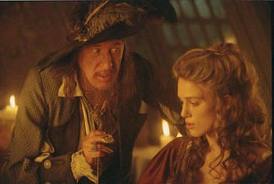
Such cases remind me of the movie, Pirates of the Caribbean: The Curse of the Black Pearl. In it, the fair maid, Elizabeth, is negotiating with the pirate Barbossa to exchange a piece of pirate gold for the safety of her town. 


Geoffrey Rush and Keira Knightley
Pirates of the Caribbean: The Curse of the Black Pearl
Barbossa: Very well, you hand it over and we'll put your town to our rudder and ne'er return.
Elizabeth: [she hands it over] Our bargain?
[Barbossa walks away from her]
Bo'sun: Still the guns and stow 'em, Signal the men, set the flags and make good to clear port.
Elizabeth: Wait! You have to take me to shore. According to the Code of the Order of the Brethren...
Barbossa
: First, your return to shore was not part of our negotiations nor our agreement so I must do nothing. And secondly, you must be a pirate for the pirate's code to apply and you're not. And thirdly, the code is more what you'd call "guidelines" than actual rules. Welcome aboard the Black Pearl, Miss Turner. 


For writers, I believe, like Barbossa, there are very few absolutes. (I've read that the one unbreakable rule is that one should never start a story with "And," but I'm sure there are stories that begin that way.) Tenets like "show, don't tell" and "no back story in the first 100 pages" became rules for a reason, but writers would be well advised to consider them "more what you'd call 'guidelines' . . ." They are often the best advice. But they're not right for every situation. Sometimes, breaking the rules helps a writer find a better way to tell the story. 


Some writing coaches agree with me, but advise writers to be sure to know all the rules before attempting to break any of them.


That's probably good advice . . . but it's not a rule.