Pages

Wednesday, September 7, 2011

Writers' Rules

At our regular meeting of the Bethlehem Writers Group last night, one of our members quoted some advice she had heard from a well-known agent that one should not have any back story in the first 100 pages of a novel. The pronouncement was greeted with a general moan. 


Writers often hear such arbitrary rules. Good ideas offered one writer are passed on to others until they are nearly etched in stone. Some authors try to follow them all to the point of sacrificing storytelling for the sake of the "rules." 


One of the more mineralized bits of wisdom for fiction writing is "show, don't tell." In fact, we usually hear it quoted by one member or another at each of our meetings. It's sometimes hard to figure out exactly what this means. Looking at an example of the two ways of accomplishing the same thing might help. 


Suppose we have a man and a woman involved in a discussion. In the dialogue, we hear their words, but through the narrative we learn about the feelings behind those words. We can do that through showing (e.g. "She pursed her lips, shook her head, and looked away,") or through telling (e.g. "She did not agree with what he said, but didn't want to say so.")


With with the former, we, as readers, feel more like we're there in the scene, watching it unfold, and interpreting the woman's body language based on our own lives and experience. With telling, we might actually know a little more about what is going on inside the woman's head, but with showing we feel more connected. That connection is what can keep a reader involved and turning pages, which is why "show, don't tell" became a rule.


Still, there are times when telling is the best way to get through a section. If you want the reader to know something, but it's not worth half a page to show them, then telling is the more efficient means. The rule "show, don't tell," isn't unbreakable.

Such cases remind me of the movie, Pirates of the Caribbean: The Curse of the Black Pearl. In it, the fair maid, Elizabeth, is negotiating with the pirate Barbossa to exchange a piece of pirate gold for the safety of her town. 
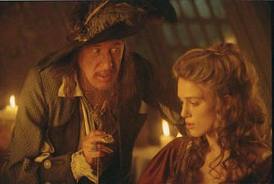


Geoffrey Rush and Keira Knightley
Pirates of the Caribbean: The Curse of the Black Pearl
Barbossa: Very well, you hand it over and we'll put your town to our rudder and ne'er return.
Elizabeth: [she hands it over] Our bargain?
[Barbossa walks away from her]
Bo'sun: Still the guns and stow 'em, Signal the men, set the flags and make good to clear port.
Elizabeth: Wait! You have to take me to shore. According to the Code of the Order of the Brethren...
Barbossa
: First, your return to shore was not part of our negotiations nor our agreement so I must do nothing. And secondly, you must be a pirate for the pirate's code to apply and you're not. And thirdly, the code is more what you'd call "guidelines" than actual rules. Welcome aboard the Black Pearl, Miss Turner. 


For writers, I believe, like Barbossa, there are very few absolutes. (I've read that the one unbreakable rule is that one should never start a story with "And," but I'm sure there are stories that begin that way.) Tenets like "show, don't tell" and "no back story in the first 100 pages" became rules for a reason, but writers would be well advised to consider them "more what you'd call 'guidelines' . . ." They are often the best advice. But they're not right for every situation. Sometimes, breaking the rules helps a writer find a better way to tell the story. 


Some writing coaches agree with me, but advise writers to be sure to know all the rules before attempting to break any of them.


That's probably good advice . . . but it's not a rule.

Thursday, August 4, 2011

A Dialogue on Dialogue

"What are the keys to writing good dialogue?" I asked a writer friend.

"Well, as you well know, I am an avid reader and the author of several yet-to-be-published books, and I know about such things from writing many manuscripts starting when I was only seven years old growing up in Saskatchewan. It makes sense that you would ask me, your Facebook friend, and a person who, while raising seventeen cats, still has time to write every day. One thing you should always do is put a character's back story into your dialogue. It tells the reader about your character and is much livelier than including it in narrative."

"So I see."


"And ending sentences with a preposition, once totally taboo, is something you can use dialogue for."

"I thought we used dialogue to relate what characters said."

"That reminds me. Never use 'said' for tagging your dialogue. The English language is full of much more interesting words to use for a dialogue tag. Try ranted, exclaimed, reposted, averred, proclaimed, and so on. 'Said' will just disappear so that the reader will only focus on what the characters are saying instead of on your creative way of expressing it."

"Okay. I can do that," I said. "How can I make my dialogue sound natural?"


"Well, uh, part of your, um, problem could be that when people are talking in, uh, real life, sometimes they . . . pause . . . or, uh, su-su-su-stammer, or, um, re-reach for just the right . . . turn of phrase . . . and, um, writers sometimes leave this out and make their dialogue, uh, unnatural. By putting it into your dialogue, you'll, uh, make the reader feel like . . . he or she . . . is reading what a real person is, um, saying."

"Isn't that a little hard to read?"

"Really, Sam? Isn't it clear, Sam? Which reminds me, Sam, that making your dialogue personal by mentioning the other character's name over and over again, lets you know who's talking. You understand don't you, Sam?"

"My name's Carol."


"And do not use contractions. I could not be clearer. I would like to think you will follow my advice. I cannot imagine that you are unable to understand why. This is not email, you know. It is formal writing."

"I'll try to remember that."


"Nother whay to mike somethin' sound jes' raht, is to use spellin' that'll tell the reedah the kinda accent yer kerkter haz."

"Hunh?"

"And always write in complete sentences. Never use a single word or two as a response. It shows a disrespect for the reader."

"How?"

"Trust me. Writing dialogue is easy. Why when I write dialogue I always try to make sure that the speaker, or in this case the character who is represented on the page by the author as having spoken, gives lengthy and thorough responses to all questions posed. Thereby, they can expound upon the important issues that surround the matter at hand, whatever that might be in the context of the story the author is attempting to tell. There is a reason that Shakespeare used the soliloquy. It was so that an individual character could command the stage, singularly and alone, for all to see, to talk, perchance to muse, upon a subject without interruption from anyone else. Being able to hold the floor with other characters on stage, or in the room, so to speak, or on the page, is even more important, for any character who is worth writing about should be able to go on and on and on and on and on and on. After all, that is the way people actually talk, never allowing for interruption until they have expressed a complete, well-designed, and gracefully executed barrage of language with or without meaning. Such is the way of the world, and it is in this manner that you should write your dialogue. Otherwise it lacks verisimilitude, which is a word, you, as a writer, should know means having a quality of realism, or of being true to reality."

"I don't think people really converse that way."

"Think not? My bad. But I'm just too sick to care. Because my dialogue is always surge, you, my reader peeps, no matter when you read my work, will know that I am awesome, because I always use the latest language fads to appear hep and up to date."

"Hep?"

"And don't forget to repeat yourself. You shouldn't forget to repeat yourself. People do it all the time. For emphasis, or to be sure they understand. To be sure they understand what's been said. People do it all the time. You should repeat yourself."

"Doesn't that make it a bit tedious?"


"Such palaver. You will also want your dialogue to limn a protagonist with whom your reader can colligate. Write dialogue that imbues the character with perspicacity and sagacity."

"I don't know what half those words mean. Should my readers have a dictionary close at hand, or should I just include a glossary?"


"If you follow all of these rules, you, too, might be able to write several unpublished manuscripts with dialogue as good as mine."

"Thanks," I said. I think I'm sorry I asked.

Thursday, July 14, 2011

Lost Cat!

We've all seen posters and classified ads for lost pets. They always makes me a bit sad. I have had one or more pets nearly all my life, and feel for the loss and worry these people are suffering. We know how they love their pets--each with its own special place in their hearts.

Like many writers, I have a hard time using "it" to describe a pet, but in our gender-neutral language, only homo sapiens are granted the personal pronouns of "he" or "she" in formal writing. This, however, is not formal writing, because I am writing about my missing cat. She is a three-year-old calico, indoor-only cat. She slipped out last Sunday, and we've seen no sign of her since. We've searched everywhere she might have gone, talked to neighbors, called local shelters, left out food, distributed flyers, and put ads in the classifieds, but after four days, she is still missing.

She was part of a litter of five that was born in our garage. We had successive generations of feral cats in and around our yard during the preceding years, but when the new litter was born right in our garage, we decided to collect the kittens and hand raise them so that they could become someone's pets. It turned out that they became our pets. We've had them since they were three weeks old, and they have always been indoor cats.


Our missing kitty is a bit shy and is not much of a cuddle-cat. She doesn't like to be picked up, and only tolerates stroking when necessary to get a treat, so she would be very hard for a stranger to catch. But she is lively and funny and vocal, and is very much missed.

People are kind. A neighbor called upon seeing a cat who, it must be said, despite the photos we put on our flyer bore no resemblance to ours. It's the thought that counts. Another person responded to our Craig's List ad that we shouldn't lose hope. Her cat came back after 10 days with no sign of him. That helped quite a bit.

But what will help the most is an actual sighting of her--or her return. While she is out in the world, where she has no experience fending for herself, there is not much more we can do--except worry.

Saturday, July 2, 2011

Can You Find Independence Day on a Calendar?

If so, you're among the 94% of Americans who can. Unfortunately, that means 6% of us cannot.

Ignorance of our past is nothing new. Jay Leno has poked a lot of fun at Americans who think the first flag was sewn by Betty Ford, the first president was Benjamin Franklin, and Louis Armstrong was the first man on the moon. These are some of the same people who can't name the vice president or tell you in which country you would find the Panama Canal. We laugh and assume such ignorance is rare, and that Leno had to ask a lot of questions before getting the answers he put on the air. 

Now, however, we have more cause for concern. The Department of Education reported in May that only 20% of 6th graders, 17% of 8th graders, and 12% of high school seniors scored at the "proficient" level for history on the National Assessment of Educational Progress (NAEP). Only 1% of seniors scored as "advanced."

If high school seniors enter college knowing very little about history, the colleges must spend time teaching things that their students should already know. In turn, this means that colleges do not have the time to give students a higher level of education on the subject, leaving college-educated adults with minimal knowledge and understanding of history.

And it's not just history. Knowledge of all social studies is lacking. Facebook has revealed Americans' ignorance of geography, ranking 117th among 193 countries. Knowledge of civics is similarly poor. In 2009, when Oklahoma high school students were given the U.S. citizenship test--the test given to those who hope to become naturalized U.S. citizens--only 2.8% passed.  Compare that to the 92% pass rate for those from other countries who are seeking U.S. citizenship. In addition, only 23% of the Oklahoma students tested correctly identified the first president of the United States. Subsequently, Newsweek found that 38% of their sample of 1000 Americans also failed the citizenship test. See the test questions Newsweek used here. 

This is embarrassing, but so what? Is this really such a problem?

Putting aside the often-quoted maxim that those who do not remember history are doomed to repeat it, in a democracy, this is very important. The majority of recent high school graduates meet the age requirement for voting. Citizens can run for office. But can a democracy thrive if its voters are ignorant, or if they put ignorant people into office? 

I'm not talking about the slips of the tongue to which all politicians fall victim. There is no doubt that President Obama knows that there are 50 states in the U.S.--not 57 as he once said in an off-hand comment at a campaign stop. Michele Bachmann, if she had thought about it, probably would not have said that Concord, New Hampshire was where the "shot heard 'round the world" was fired. Campaigning is exhausting; people make mistakes. Just ask Joe Biden. (He's the vice president, you know.)

But when they refuse to acknowledge their own ignorance, we have a problem. We saw this when Michele Bachmann refused to admit her error in saying, "But we also know that the very founders that wrote those documents [e.g. Declaration of Independence] worked tirelessly until slavery was no more in the United States." Bachmann's statement sounded good, but the last surviving signer of the Declaration of Independence, Charles Carroll, died in 1832, decades before the end of slavery. She then referred to the abolitionist efforts of John Quincy Adams, who was not quite nine years old when we declared our independence, and who died in 1848, nearly fifteen years before the Emmancipation Proclamation. This rhetorical error was not nearly as important as the content of the rest of her speech, but because she refused to admit that she misspoke, it has become the only thing people know about her talk.

Sarah Palin staunchly defended her description of Paul Revere's famous ride to secretly warn colonists of the movements by the British regulars as, ". . . he who warned, uh, the, the British that they weren't gonna be takin' away our arms, uh, by ringing those bells, and, and, um, making sure as he's ridin' his horse through town to send those warning shots and bells that, uh, we were gonna be secure and we were gonna be free." It was a forgivable blunder if she owned up to it, but instead she stood by it saying she knew her history. What is even worse, some of her supporters tried to change the Wikipedia page on Paul Revere to coincide with her erroneous statement.  Fortunately, Wikipedia closed the page to revision when it discovered the effort.

Ignorance can be cured, but a dogged persistence in, and defense of it cannot. Nor can the willful distortion of "facts" so often engaged in by politicians and pundits.

I am fortunate to occasionally co-teach a day-long seminar on civics for high school students. These students are hand selected by civic organizations for this special program, and they give up some of their free time to attend. They are usually well informed and enthusiastic about the subject. And they always pass the U.S. citizenship test. These young people give me hope for the leaders of tomorrow, but they are few. What about the rest of our young people?

President Obama has called for reform of No Child Left Behind which focuses on achievement in reading, writing, and mathematics. Knowing that we're doing so poorly in teaching our children history, geography, and civics, perhaps we can take this opportunity to refocus our energies in that direction. Our schools are not just there to generate test scores. They help create informed and involved citizens.

What do you think? Are social studies as important as reading, writing, and math? And on this Independence Day weekend, are you willing to take a challenge?

Take the sample test questions on the NAEP History assessment here. There are five questions each at three different levels: 4th grade, 8th grade, and 12th grade. Let us know how you did.

Thursday, June 30, 2011

The Serial (and Very Serious) Comma

To comma, or not to comma . . .

That question has been debated among writers for some time. Since a comma is used to replace the word "and" when listing several items in a sentence, must one use a comma before the last item listed even when there is an "and" before it? Example (with the debated comma): I bought bread, apples, and peanut butter at the grocery store.


Over the years, the University of Oxford Guide to Style has insisted upon including the last comma in this situation. The serial comma has become so identified with the university that it is known as the "Oxford comma." Oxford's position has been echoed by the Chicago Manual of Style, Elements of Style by Strunk and White, and the BBC.  (Thanks to the Oxford comma, you know when reading the preceeding sentence that Elements of Style is by Strunk and White, not by Strunk, White, and the BBC.)

Others have disagreed about the necessity of the final comma. The AP Stylebook, for instance, says that the comma before the last item in a list should be omitted unless it is necessary for comprehension. The AP Stylebook is primarily intended for journalists, but we have seen that journalistic style has a way of entering the mainstream. Consider, for example, the greater acceptance of the use of "alright," when traditionally (and more correctly) it should be written "all right."

So when word came out that the University of Oxford was abandoning it's own comma, punctuation nerds felt the ground shake a bit. Cries of angst arose on Twitter and Facebook as people tried to make sense of it all. It took several hours before it became clear that only the public relations office at the university had changed its guidelines for press releases to journalists, having no affect whatsoever on the advice offered in the Guide to Style. 

So grammar geeks can heave a sigh of relief. Their Oxford comma is safe. Everything, it appears, is alright.

Thursday, June 23, 2011

Following Police Orders vs. Exercising Your Rights

I respect the police. They have a very difficult job--one that most people are unwilling or unable to do. They never know from moment to moment, on duty or off, when someone might produce a weapon and try to end their lives. Yet, they are sworn to protect the public, and put themselves at risk for us every day. Even after their shifts end, they cannot turn off their instincts, grounded in their training and experience, to be vigilant and aware of their surroundings--to identify dangers before they become tragedies.

Sometimes, however, their instincts can lead them to go too far. Take, for example, the case of Emily Good, a resident of Rochester, NY, who, last month, videotaped a traffic stop outside her home. Ms. Good is a self-proclaimed activist who, earlier this year, was arrested with others who were trying to prevent a home foreclosure. But this time Ms. Good was standing in her own yard recording what was happening in the street right in front of her house.

After the person stopped was under police control, one of the officers addressed Ms. Good directly. He told her he did not "feel safe" with her standing behind him. She asserted that she clearly had no weapons and that it was her right to observe and record what was happening in her neighborhood from her own yard. The police officer said that she seemed anti-police from some unspecified thing he claimed she said to him before she started recording. (Other witnesses say Ms. Good said nothing to the officers before beginning to record them.) Refusing to return to her house as the officer suggested, Ms. Good was arrested for the crime of "obstructing governmental administration," for not following police orders. You can see her video here:


Putting aside for a moment that it is difficult to imagine how observing and recording an event from a distance is "obstructing governmental administration," one still has to wonder why this confrontation ever took place. Perhaps the officer did not feel safe at first. There was someone standing several feet away, whose intentions were unknown, while their attention was focussed elsewhere. Taking control of a situation is the best way to avoid having things get out of hand. But after realizing that the witness did not pose a physical threat, why did the officer pursue it? A less generous interpretation might be that the officer did not want his actions recorded in case they might tend to show him in an unfavorable light. If that were his motive, he certainly failed to avoid that unhappy result. But as you watch the video, it seems that the officer just doesn't like that a person refuses to automatically do whatever he says.

Granted, Emily Good did not give in, but she was fully within her rights as a citizen to do what she was doing. The fact that she continued to record the encounter after the officer threatened her with arrest showed a certain grit and determination that she will now have to defend in court.

So where does one draw the line between obeying the police and standing up for one's rights?

Certainly there are times when bystanders need to follow police orders for their own safety or the safety of others, even if they don't understand why. But there are also times when the police need to be reined in and told that they have gone too far.

It seems to me that one of the best ways to protect our rights as citizens is to use them. I also believe that peacefully recording the police from a distance while they are engaged in a traffic stop should not subject one to arrest. Sometimes, as with the Rodney King police brutality case, only a bystander with a camera can help a victim get justice. As the lauded Supreme Court justice, Louis D. Brandeis, said, "Sunshine is the best disinfectant."

What do you think? Would you have done what Emily Good did? Do you think the officer's reaction was justifiable? Just how far would you go to defend your rights?

Monday, April 4, 2011

Is it "Next Year" Yet?

As you probably know by now, I grew up in New England--Massachusetts, to be precise. And, like many of my peers, I grew up to be a life-long Red Sox fan.

Now, when I was a kid, the Red Sox were not known for winning championships. The last one they had won was in 1918, so there weren't too many people around who could remember it. But every season, we would root for them, and hope that this was the year when they would beat the odds, and bring us another World Series Championship. When they came close (and they nearly always came close) but didn't win, we'd say, along with fans of most other teams, "Just wait 'til next year."

Our "next year" finally came with a World Series win in 2004, and, surprise, surprise, again in 2007. This year, they're predicted, along with the Philadelphia Phillies--my new hometown team--to make it to the World Series again.This year, they say, the Sox have put it all together: phenomenal pitching, great fielding, and hitting beyond belief. 

But Boston lost their first three games and are tied for last in the AL East. What about our dominating pitching staff? In our second game of the season they let in twelve runs. Not a very auspicious beginning.

To take our minds off of our troubles, a bunch of us decided to participate in a fantasy baseball league. I've never done this before, so I knew I would make some rookie mistakes. We held our draft yesterday, and I really had no idea how it worked. The only thing I knew for sure was that you had to draft a player for each position, six utility hitters, and one entire squad for pitching--not individual pitchers. 

I did some homework. Okay, my husband helped me--even though he was drafting a competing team. He pulled out his many scouting books, and researched everyone online. (I told you we New Englanders were fans!) All I knew was that I wanted to draft Kevin Youkilis, the Red Sox Gold Glove first baseman, who this year will be going back to his original position, playing third base. He once told the manager that he would be willing to play any position except catcher. How can you not like a guy like that?

And I knew I didn't want to draft any Yankees. There was no way I would end up cheering for a Yankee player just because it would help my fantasy team.


But I was so worried about pitching that when my first pick came (8th out of 10 in the first round), I picked my pitching squad. Apparently, that was against protocol. Other players seemed shocked, and suddenly were flinging papers everywhere, trying to adjust their next picks. Hmmm--throwing off the competition. Maybe I'm better at this than I thought. Which pitching squad did I pick? The Phillies. You might think this a bit disloyal, but the Phillies are undefeated, and in first place in their division, their league, and all of Major League Baseball!

Everyone was given 90 seconds per pick, so I expected the draft to take forever, giving me a chance to sort through and select my players with care. But everyone picked so quickly, that before I knew it, it was my turn again, and I got Youkilis! Fist pump of joy! On my next pick I got Dustin Pedroia, also of the Red Sox--our second baseman and former Rookie of the Year and AL MVP. Two fist pumps of joy! 

The draft was stressful, but went so fast, I hardly knew who I had until it was all over. It turns out, I have a pretty good team. At least they look pretty good on paper--so far. So I'm pulling for my Sox, the Phillies, and my fantasy team, "Mama's Boys." I hope they all win.

But if they don't, well, just wait 'til next year!